
Hire a Marketing Consultant for Small Business or Agency?
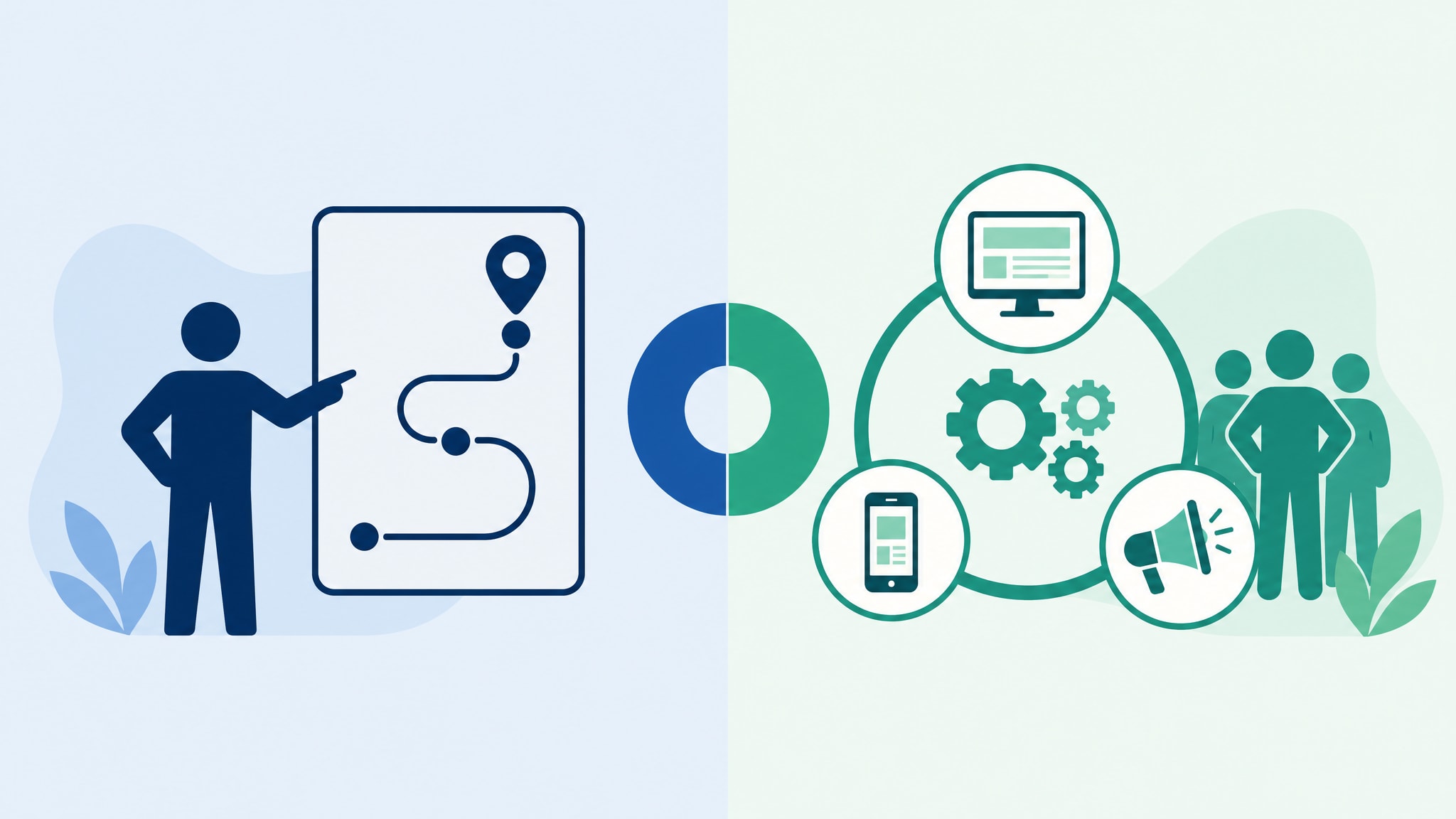
Growing a service business means your marketing budget has to turn into booked jobs and revenue, not just brand awareness or social likes. When you're ready to bring in outside help, the decision usually comes down to this: do you hire a marketing consultant for your small business, or bring in a full-service agency? Both models have merit, but they solve different problems for trade and professional service providers who need steady lead flow. Get this distinction right and you avoid paying for resources that don't match your growth goals.
Marketing Consultant vs Agency: Defining the Models for Service Businesses
A freelance marketing consultant works as an individual strategist. They give advice, run audits, and take on project work, but they don't usually manage ongoing execution. You bring them in to diagnose problems, build a roadmap, or train your staff, and then implementation falls back on your internal team or another vendor. This works well when you already have capable people in-house who just need direction or specialist knowledge to fill a gap.
Agencies are integrated teams. They combine strategic planning with hands-on execution across multiple channels at once. They own the tech stack, manage ad spend, produce content, and handle the technical integrations that turn clicks into qualified leads. For service businesses like plumbers and electricians, this matters because generating leads takes coordinated effort across Google Ads, SEO, and social media, not a set of isolated recommendations. It's a common pattern: these businesses hire a consultant for initial strategy, then switch to an agency once they need consistent weekly lead flow across all three channels at the same time.
The real difference is where responsibility stops. A consultant hands you insights and leaves the execution to you. An agency takes responsibility for driving measurable outcomes through ongoing management and optimisation. Your choice depends on whether you're short on strategy or short on the capacity to execute it, week after week.
Cost Comparison: Freelance Marketer vs Agency Pricing Structures
Most freelance marketing consultants in Australia charge between $100 and $200 an hour, while agency retainers for small service businesses typically run $2,000 to $5,000 a month depending on scope. The lower hourly rate looks attractive at first, especially when budgets are tight and you only need occasional guidance. But that comparison misses the total cost once you factor in tools, software subscriptions, ad spend management fees, and content production.
Consultants often bill separately for every task. Strategy sessions, campaign setup, reporting, and revisions each show up as their own line item. You may also need to buy your own analytics tools, CRM integrations, and design software, because independent operators rarely bundle enterprise-grade platforms into their fee. These hidden costs stack up fast once you need ongoing support rather than a one-off audit.
Agency retainers bundle strategy, execution, technology access, and reporting into one predictable monthly investment that scales with you. You're not buying separate software licences or hiring extra freelancers to cover what your consultant can't do. For service businesses needing consistent lead generation across several channels, cheaper upfront fees often end up costing more over time, because fragmented spending adds up faster than one integrated service.
None of this means agencies are always cheaper. It means the real cost comparison looks past the hourly rate, to total value delivered over twelve months.
Accountability and Reporting: Who Owns Your Growth Outcomes?
Solo consultants often deliver excellent strategic recommendations without carrying any responsibility for whether those recommendations make you money. The engagement typically ends once the roadmap lands in your inbox, and you're left to work out whether the plan worked, or why it didn't. That's the accountability gap: brilliant strategy can sit right next to poor results, because no single party owns the outcome from diagnosis through to execution.
For a service business, marketing ROI has to be measured in booked jobs and revenue attribution, not impressions or clicks. That takes integrated tracking systems, and most solo consultants can't build those alone. Agencies tie their performance contractually to KPIs like qualified leads, conversion rates, and customer acquisition cost, because they control both the strategy and the execution. That alignment means someone is watching your campaigns weekly and adjusting based on real data, not theory.
You deserve a partner whose success depends on yours, not someone who gets paid whether or not your phone rings. When you're evaluating a hire, ask them directly how they track revenue attribution, and what happens when targets are missed. A vague answer about "brand building" or "engagement metrics" tells you you're talking to a consultant, not a growth partner.
Scalability Challenges: When Solo Consultants Hit Capacity Ceilings
Service businesses tend to outgrow individual consultants once demand picks up across SEO, paid ads, email automation, and CRM integration all at once. One person can't hold expertise across all of those disciplines while also managing client communication, reporting, and strategy at scale. The risk shows up hardest during peak season, exactly when you need fast campaign adjustments and your consultant is already stretched across other clients.
Growth stalls when your marketing provider's availability becomes the bottleneck, not the market. You might have the budget to increase ad spend or launch a new service line, but a solo operator can't onboard new campaigns fast enough without quality slipping somewhere else. That ceiling hits exactly when momentum matters most, and you're stuck choosing between waiting for availability or bringing in extra freelancers who don't know your business yet.
Agencies keep bench strength across specialisations, so they can scale your campaigns without you having to juggle multiple vendor relationships. Need to add a channel or increase volume? The infrastructure is already there to absorb it, no renegotiated contracts, no onboarding new contractors. Spotting signs your business needs a marketing agency early stops growth plateaus that come from resource limits rather than market limits.
Your marketing partner should accelerate growth, not cap it at their own bandwidth.
When to Hire a Marketing Consultant for Small Business Projects
Hiring a consultant makes real sense when your need is specific and bounded, and doesn't require ongoing execution. A one-off audit of existing campaigns, rebranding strategy, or training your staff on a new platform are all good consultant engagements. These projects benefit from an outside perspective without needing the sustained involvement that lead generation work demands.
Consultant engagements work best when you already have execution capacity, whether in-house or through another vendor you trust. If your team can act on the recommendations competently, a consultant's strategic input multiplies what you've already got instead of duplicating it. The model fits a discrete project, not a continuous growth operation.
Bringing in a consultant also makes sense during a transition, when you're deciding whether to build internal capability or outsource for good. Their assessment helps you see what skills you actually need versus what can stay external. Just be clear going in: this is a diagnostic or educational engagement, not a stand-in for the accountable execution that drives consistent lead flow.
Choosing a Marketing Partner for Small Business Growth in 2026
Evaluating partners in 2026 takes criteria specific to service businesses, not generic digital marketing credentials. Industry experience matters a lot, because trades and professional services run on different customer journeys, compliance requirements, and seasonal patterns than e-commerce or B2B SaaS. Ask for case studies showing booked job growth for businesses like yours, not just traffic increases or follower counts.
Reporting dashboards should give you real-time visibility into lead sources, conversion paths, and revenue attribution, without you having to manually compile any of it. Integrated service offerings also stop the coordination failures you get when separate SEO, PPC, and web vendors start blaming each other the moment results stall. Jumpgro positions itself as an accountable growth partner for service businesses, combining strategic planning with hands-on execution across SEO, paid ads, websites, and CRM systems under one roof.
Use our checklist for hiring a marketing agency to evaluate candidates against these criteria systematically, rather than relying on sales pitches alone. Trade businesses specifically should check the guidance on choosing a digital marketing agency for tradies to make sure there's industry alignment. Weighing broader resourcing decisions? The marketing agency vs in-house team comparison is worth a read before you commit to either path.
The right partner shows they understand your business model before they start talking tactics or price.
Next Steps: Evaluating Your Marketing Help Options in Australia
Start by honestly assessing your current stage, your available budget, and your specific growth goals for the next twelve months. Early-stage businesses with tight budgets and a discrete need can genuinely do well with a consultant engagement before scaling into an agency partnership. Established service businesses that need consistent lead flow across multiple channels tend to get better ROI from an integrated agency model, because it cuts out the coordination overhead.
Ask yourself whether your bottleneck is strategic clarity or execution capacity, because the answer determines which model actually solves your problem. Hybrid approaches, periodic consulting layered with ongoing agency execution, exist too, for businesses in transition between stages. There's no universally correct answer here. Just the option that fits where you are now, and where you need to be by year-end.
If you're weighing these options for your service business, booking a discovery call gets you clarity without commitment. We can talk through whether a consultant, an agency, or a hybrid approach fits your situation, and help you get a digital marketing quote tailored to what you need. Even if we end up pointing you toward another model, that conversation gives you a framework for evaluating any provider you choose next.