
Marketing Agency for Home Services Businesses: What to Expect
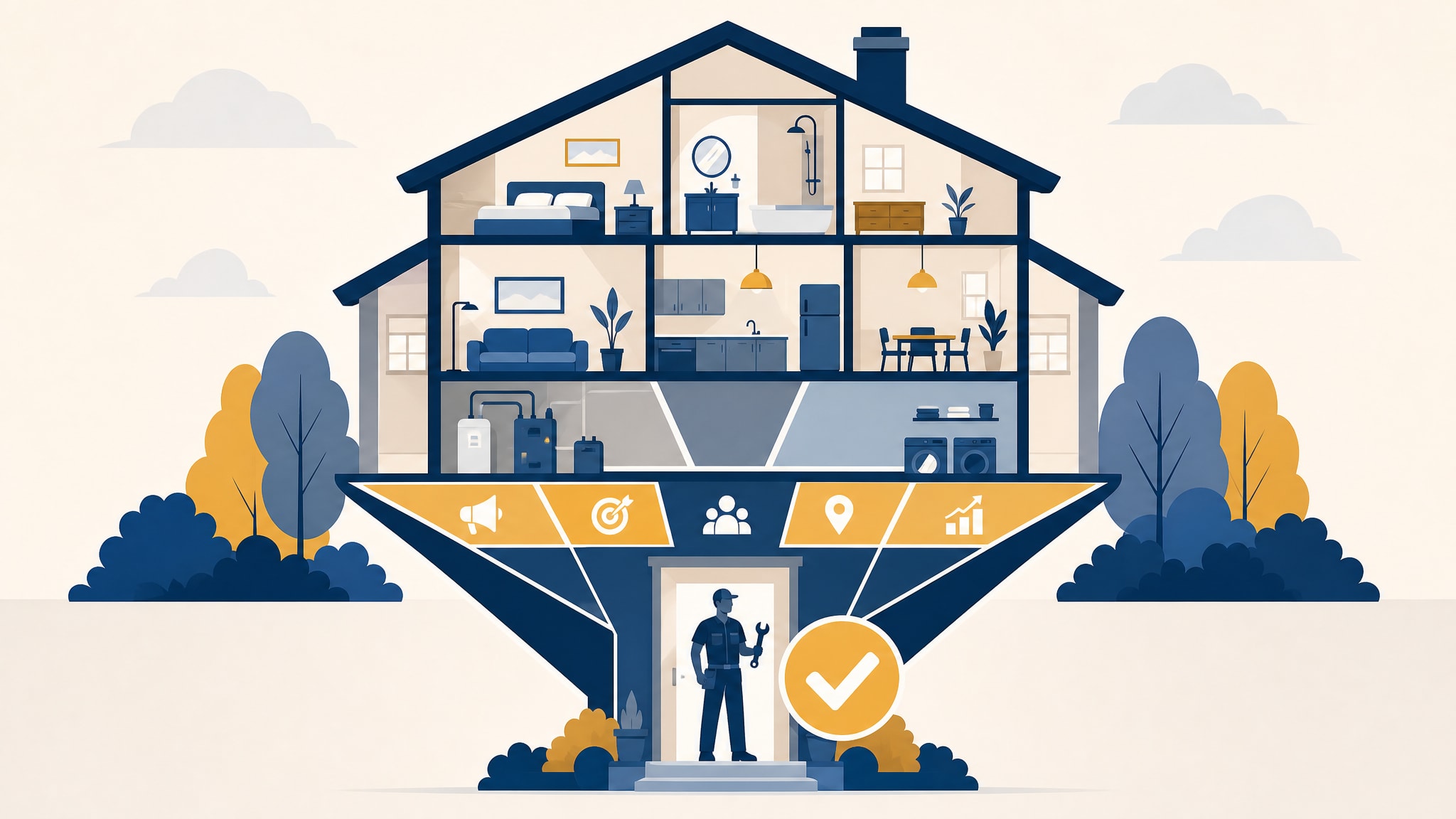
Growing a home services business takes more than showing up in search results. It takes a strategy that respects the urgency and trust involved in inviting strangers into people's homes. Your customers are often in distress or making high-trust decisions, which calls for different messaging and funnel architecture than a standard e-commerce or B2B campaign. A generic digital approach rarely captures that nuance. That's why partnering with a specialist marketing agency for home services businesses is often the difference between paying for clicks and booking jobs.
This guide breaks down what you should expect from a growth partner who actually understands your vertical, whether you run a cleaning franchise, a landscaping crew, or an HVAC company. We focus on outcomes like revenue and appointment volume, not vanity metrics that look good in a report but don't pay the bills.
Why Home Services Marketing Requires a Specialist Partner
Your customers aren't browsing for entertainment. They're solving an immediate problem or protecting their most valuable asset. That intent creates a high-stakes environment where trust signals and speed-to-lead matter far more than brand awareness or social likes. A missed call during a burst pipe emergency is lost revenue forever, not just a bounced visitor, and your partner needs to understand that.
Specialist agencies operate as growth partners who understand booking cycles, not as generic lead generators who just pass along form submissions. The sales cycle for a $15,000 landscaping renovation looks nothing like the sales cycle for a $200 pest inspection, and each needs its own nurturing sequence and attribution model. Jumpgro positions itself as a results-driven partner focused on measurable growth for small to mid-sized service businesses, moving beyond the vendor relationship to deliver momentum and outcomes. If your current provider can't explain how their work changes your job book next Tuesday, they're managing tasks, not driving growth.
A generalist agency might bolt e-commerce tactics onto your service business, ignoring local geography, seasonality, and the role phone calls still play. That misalignment burns budget on broad keywords that attract DIY researchers instead of homeowners ready to hire. Your marketing has to match reality: your customer's decision window is often minutes or hours, not weeks.
Core Deliverables from a Home Services Marketing Agency
You deserve clarity on what you're actually buying when you sign a retainer, beyond vague promises of "digital presence." A competent marketing agency for home services businesses delivers specific, measurable assets tied directly to revenue and job bookings. Vague deliverables like "brand building" or "content creation," with no conversion mechanism attached, are a red flag for a business running on tight margins.
Google Business Profile optimisation is the non-negotiable foundation for any local service provider aiming to dominate the map pack. Your profile needs fresh photos, accurate service areas, and prompt review responses to stay relevant to Google and to the customers searching it. Read our detailed breakdown on Google Business Profile optimisation to see the technical details that drive map visibility.
Conversion-focused website builds, tailored to your service areas, are the second pillar of effective home services marketing. These sites prioritise mobile speed, clear calls-to-action, and trust indicators over award-winning design that looks great but fails to convert a distressed homeowner. Getting the balance right between paid and organic channels matters too, so our comparison of SEO versus Google Ads for service businesses is worth a read before you set channel priorities.
Review generation needs to be automated and built into your post-job workflow so social proof builds at scale. Relying on manual requests, or hoping satisfied customers leave feedback on their own, leaves your reputation to chance and starves your funnel of its most powerful asset. Every deliverable should trace back to a scheduled appointment or a signed quote.
Tailored Strategies Across Cleaning, Pest Control, Landscaping and HVAC
Treat all home services as one category and you'll get mediocre results, because each vertical runs on different economics and different psychology. Marketing for a cleaning business usually leans on recurring subscriptions and referral incentives, which looks nothing like the one-off, project-based funnels renovation or repair tradies use. Your agency should be fluent in these differences before you hand over your card.
A landscaping marketing agency might lead with visual portfolio showcases and spring and summer campaign bursts. An HVAC marketing agency in Australia focuses on emergency response keywords and winter maintenance reminders instead. Pest control marketing sits in between: it needs compliance-aware messaging around chemicals and safety, plus seasonal spikes for termite inspections and rodent exclusion. These differences shape everything, from ad copy tone to landing page structure to email nurture cadence.
Emergency trades need always-on bidding and instant-response automation, because demand doesn't respect business hours. Planned services like landscaping or deep cleaning allow for a longer consideration phase, retargeting, and educational content that builds authority before the sale. Run a one-size-fits-all template across these different models and you'll burn budget on irrelevant impressions while frustrating people looking for a specific fix.
Seasonality also shifts hard by region and trade, so your campaign calendar has to reflect local weather and local rhythms. A proactive partner sees these shifts coming months out, prepping assets and adjusting bids before demand peaks or drops. React to seasonal change after it's already happened, and you're always chasing the market instead of leading it.
Building Booking Funnels That Convert Enquiries to Jobs
Traffic means nothing if it doesn't turn into scheduled work, yet plenty of agencies stop reporting at the click. A complete booking funnel owns the whole path, from ad impression to confirmed calendar slot, and strips out friction at every stage. Your marketing partner should own lead quality and conversion rates, not just top-of-funnel volume.
Mobile-first landing pages are mandatory, since most home service searches happen on a phone in a moment of urgent need. These pages need to load instantly, put click-to-call buttons above the fold, and keep forms short so there's minimal typing on a small screen. A solid CRM and website package for tradies makes sure no lead slips through during peak periods or after hours.
Instant quote tools and automated scheduling cut abandonment by giving price-sensitive customers immediate answers instead of a wait for a callback. For complex jobs where instant pricing isn't possible, automated SMS follow-ups and AI-assisted triage keep prospects warm while your team sleeps. The goal is simple: shrink the gap between someone expressing intent and someone committing.
Follow-up automation bridges the gap between enquiry and booking. Speed-to-lead decides win rates in a competitive market, and manual follow-up breaks down during busy periods, leaving money on the table and customers drifting to a competitor. Technology handles the repetitive nurturing so your staff can focus on closing high-value jobs and doing the work well.
Seasonal Campaign Planning for Year-Round Growth
Demand in home services runs in cycles, driven by weather, holidays, and fiscal calendars that shift by trade and location. Agencies need to map campaigns to local weather patterns and demand cycles across HVAC, landscaping, and pest control to get the most from ad spend. A flat monthly budget ignores all of this, overspending in quiet periods and missing the peak.
Proactive seasonal briefing marks out a results-driven partner from a reactive vendor waiting on your instructions. Your agency should hand you a quarterly roadmap: upcoming promotions, content themes, budget adjustments, based on historical data and forecast trends. That forward planning lets you staff up properly and manage cash flow with confidence.
Winter prep for HVAC companies means shifting messaging from cooling repairs to heating tune-ups and duct cleaning well before temperatures drop. Landscapers move from installation projects to maintenance contracts and hardscaping as the growing season ends, which calls for a different keyword set and different creative entirely. Pest control firms swing between summer ant treatments and winter rodent exclusion, staying relevant year-round through deliberate segmentation.
Good planning also accounts for regional quirks that national campaigns miss, like wet seasons in the tropics or bushfire recovery periods. Localised insight makes your marketing land on community-specific concerns and timing instead of generic seasonal cliché. That's the detail that separates a specialist from a generalist running a broad template.
Review Generation and Local Trust Signals
Trust is the currency of home services, because customers let providers into their private spaces and rely on them for safety and comfort. Reviews are the main way new customers validate you against the other options in a crowded market. Without a system for gathering and showing social proof, even great advertising struggles to convert a sceptical homeowner.
Automated review requests, triggered the moment a job wraps, catch feedback when satisfaction is highest and effort is lowest. Plugging this into your CRM or invoicing platform removes the manual steps that get skipped when things get busy, so volume stays consistent no matter the workload. Responding to every review, good or bad, shows future prospects you're accountable.
Local trust signals go beyond star ratings. Community sponsorship, local partnerships, and hyperlocal content all prove geographic expertise. Real team members, branded vehicles, and finished local projects build a familiarity stock photography can't fake, and together these create a presence that feels like it belongs in the community rather than one parachuted in from afar.
Consistency across directories and platforms backs up your legitimacy and stops the confusion that sends customers to a competitor. Audit your citations regularly and check that your name, address, and phone number match everywhere your business shows up online. Discrepancies erode trust and hurt local rankings at the same time, a double penalty for a profile nobody's looked after.
Bring in a specialist agency once your internal team lacks the bandwidth or expertise to run these strategies together. Use our checklist for hiring a marketing agency to measure potential partners against these standards before you commit. For broader context on tradie-specific marketing fundamentals, our marketing agency for tradies guide has more evaluation criteria for service businesses.
Frequently Asked Questions
How long does it take to see results from home services marketing?
Paid channels like Google Ads can generate booked jobs within days of launch, provided your offer and landing pages are optimised for conversion. Organic strategies like SEO and review building typically require three to six months to gain meaningful traction and compound over time. Expect early wins from quick-fix optimisations while longer-term foundations are being built.
Should I hire a marketing agency or manage campaigns in-house?
Hire an agency when marketing complexity exceeds your team's capacity or when opportunity cost of learning outweighs outsourcing fees. In-house management works for businesses with dedicated marketing staff who can stay current on platform changes and compliance requirements. Most growing service businesses benefit from specialist expertise until revenue justifies a full-time senior hire.
What metrics should I track beyond leads and clicks?
Track booked appointments, quoted job value, and actual revenue attributed to marketing channels to measure true ROI. Cost per acquisition and customer lifetime value provide better decision-making data than impression counts or click-through rates. Ask your agency to connect ad spend to your CRM or booking system for closed-loop attribution.
How do agencies handle emergency versus planned service marketing?
Emergency services require always-on bidding, instant-response automation, and mobile-first landing pages optimised for immediate contact. Planned services use longer nurture sequences, educational content, and retargeting to build trust over extended consideration periods. Budget allocation and messaging tone shift significantly between these two modes based on customer intent and urgency.