
SEO Vs Social Media Marketing: Where Service Businesses Invest
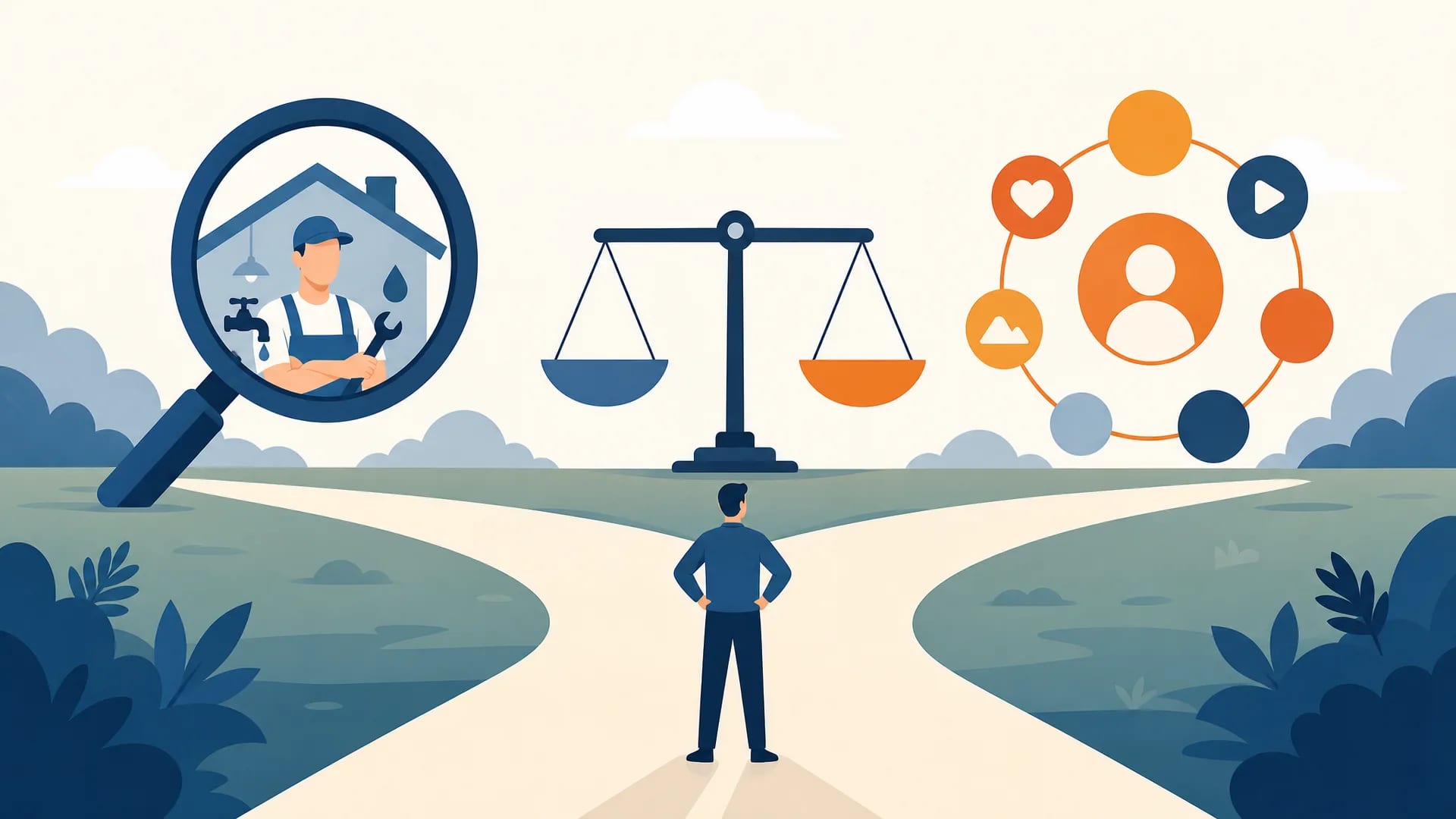
Choosing between SEO and social media marketing for service businesses feels like picking a favourite child when you actually need both to survive. You've got a limited budget, a team stretched thin, and a revenue target that doesn't care about vanity metrics or follower counts. The real question isn't which channel wins in 2026. It's which one solves your cash flow problem right now while building the asset you'll need in 2027.
This guide skips the generic marketing theory and focuses on lead quality, cost per acquisition, and time-to-result for Australian service providers. We'll help you figure out where to invest your marketing budget based on your sales cycle and your actual revenue needs, not industry hype.
The Core Difference: Buyer Intent vs Brand Awareness
Search engine optimisation captures existing demand from people actively typing a problem into Google. Social media interrupts a scroll to create new demand through familiarity and visual proof. Understanding that difference is step one in deciding where your money goes.
High-intent searches for urgent services
For most local service businesses, search intent is the strongest predictor of an immediate booking. The user has already told you exactly what they need. When someone searches "blocked drain Melbourne" or "emergency electrician near me," they're not browsing for inspiration. They're hiring.
This is where local SEO essentials stop being a nice-to-have and become critical infrastructure. Your website shows up at the exact moment of friction, positioning you as the answer to an active problem.
Social media can't replicate that urgency. Someone scrolling Instagram or Facebook is in entertainment mode, even a well-targeted ad has to convince them they have a problem before it can offer the solution.
Social discovery and trust building
Social platforms win at the top of the funnel, where trust matters more than an immediate transaction. A homeowner planning a future renovation probably isn't searching for a landscaper today, but seeing your project updates on repeat keeps you top-of-mind for when they finally decide to act.
That discovery phase builds the familiarity that makes a later search click feel safe. People are far more likely to choose a business they recognise from their feed over a stranger with similar ratings.
You can't rely on social discovery alone if your service demands immediate action. It works best as a supporting layer, one that warms up cold traffic and reinforces the credibility your search visibility already built.
Lead Quality and Conversion Rates Compared
Organic search traffic generally converts at a higher rate than social traffic for service-based websites, because those visitors arrive with commercial intent already baked in. That doesn't make social leads worthless. It means you need to judge them against different benchmarks.
Why search leads convert faster
A visitor who lands via organic search has already self-qualified. They've defined their problem and gone looking for a provider, skipping straight past the awareness stage. That shortens your sales cycle considerably.
Your landing page's job is simple: confirm you can solve their specific issue and give them an easy way to reach you. No need to educate them on why the service matters. They already know.
That efficiency is why plenty of service businesses lean on search when weighing an SEO vs Google Ads comparison for immediate revenue. Both channels grab high-intent traffic. Social needs a lot more touchpoints to get to the same place.
Nurturing social followers into clients
Social leads often need a longer nurture cycle, but they can pay off with higher lifetime value once community trust kicks in. Someone who's watched your behind-the-scenes content for six months arrives at the inquiry stage with fewer objections than a cold search visitor ever will.
These leads tend to ask sharper questions and stick around longer, because they already understand how you work before they pick up the phone. The trade-off: you're investing in content well before you see a return.
Budget for social lead generation with that timeline in mind. Expect lower initial conversion, but potentially stronger retention and referrals once those relationships mature into paying clients.
Time-to-Result and Budget Reality for SMBs
Cash flow constraints set the strategy for small service businesses. Map your channels to realistic timelines, or you'll run out of money before you see returns. Social advertising can generate bookings within days of launch. SEO typically needs six to twelve months of consistent effort before it delivers predictable lead volume.
SEO as a long-term asset
Search optimisation works like compound interest: early investment pays off exponentially later. The work you put in during 2026 to build authority and rank for competitive terms keeps generating traffic in 2027, without any extra ad spend.
That's what makes SEO sustainable for businesses running tight margins, once rankings settle. Your cost per lead drops over time, because the same content keeps pulling in more visitors without costing proportionally more.
The catch: you have to fund the growth period somehow. Plenty of service businesses lean on paid social or Google Ads to keep cash flowing during the six to twelve months organic rankings need to mature.
Social media for quick wins and cash flow
Paid social gives you immediate visibility and bookings when you need revenue now. Turn the ads on Monday, have appointments booked by Wednesday, it's ideal for filling gaps or launching a new service fast.
That speed comes at a cost: permanence. Stop paying, and the leads stop showing up. That dependency can strain margins during a slow patch.
Use social advertising for seasonal pushes or capacity management, not as your only lead source. Our guide on Facebook ads for service businesses covers how to structure these campaigns without blowing out your ad spend.
Cost Per Lead: Organic Search vs Paid Social
Comparing costs means looking past the sticker price to how each channel scales over time. Social advertising works on a rental model: costs stay flat or climb as competition heats up. SEO margins improve sharply once you're past the initial ranking phase.
Social platforms give you predictable volume at a known cost per lead, which makes forecasting easier. You know what each inquiry costs, so working out campaign-by-campaign profitability is straightforward.
That predictability caps your upside, though. Rising CPMs across Meta and TikTok mean your cost per lead will likely climb year over year unless you keep improving your creative.
SEO costs are front-loaded and harder to predict early on, but they build leverage paid channels can't match. Once you rank for high-value terms, each extra visitor costs next to nothing, your margins expand as traffic grows.
That's what makes SEO the stronger bet for businesses thinking past the current financial year. You eat higher costs early to lock in lower acquisition costs permanently. Social advertising, by contrast, locks you into paying forever.
Jumpgro's work with Australian service businesses shows that pairing Google Business Profile optimisation with social proof creates a compounding effect on local pack rankings. That combination lowers overall cost per lead by lifting organic click-through rates while also making retargeting campaigns work harder.
For accurate attribution across both channels, our framework for measuring marketing ROI will help you avoid misallocating budget based on incomplete data.
Which Channel Fits Your Specific Service Business?
There's no universal winner in the SEO-versus-social debate, because different services have fundamentally different buyer journeys. Emergency plumbing and electrical work typically sees faster ROI from search, thanks to urgent buyer intent. Landscaping and renovation businesses often lean on social media to build a visual portfolio instead.
Emergency trades and high-urgency services
If customers hire you because something's broken, leaking, or dangerous, search has to be your primary investment. Nobody browses Instagram for an emergency plumber. They search Google and call the first credible result.
Put the bulk of your budget toward high-intent keywords and holding top local pack positions. Social is a secondary trust signal here, reassuring searchers you're legitimate before they pick up the phone.
Emergency service providers should get SEO or Google Ads sorted before pouring money into social content. Missing an urgent search costs you more than any following you'd build among people who don't need you yet.
Considered purchases and professional services
Services with longer sales cycles, accounting, legal advice, architectural design, do best with a balanced approach. Prospects research for weeks before committing, so they need both searchable expertise and ongoing relationship building.
Search establishes your authority when prospects are actively comparing providers. Social keeps you visible during the weeks or months they spend deciding. Educational content earns its keep on both channels here.
Your broader digital marketing strategy should weave both together to cover different stages of the buyer journey. Skip either one and you leave a gap competitors can slide into.
Visual and lifestyle-based services
Beauty, fitness, interior design, wedding services, these often see better early ROI from visual social platforms. Your product is aesthetic and aspirational, which makes Instagram and Pinterest natural places for people to find you.
Search still matters for catching bottom-funnel queries like "wedding photographer Sydney," but social is what drives the awareness that makes those searches happen in the first place. Put real budget into visual content that shows outcomes, not just features.
These businesses can afford to lean into social earlier in their growth, because the platform matches how customers actually discover and judge them. Search becomes the bigger lever later, once brand awareness starts converting into direct inquiries.
Integrating Both Channels for Maximum Growth
The most successful service businesses treat SEO and Facebook ads as teammates, not rivals. Done right, each channel makes the other work harder and pulls your acquisition costs down.
Using social content to fuel SEO
Repurpose your best social content into blog posts, FAQs, and service pages to catch search traffic on related queries. A viral Instagram reel about common plumbing issues becomes a detailed article targeting "why is my toilet gurgling."
That gives every piece of content double mileage. Social tells you a topic has legs before you spend money producing it for SEO, cutting the risk of writing something nobody wants to read.
Video transcripts and expanded explanations also improve dwell time and engagement on your site. Search engines lean harder on those behavioural signals as they chase better user satisfaction.
Retargeting search visitors on social
Most first-time search visitors leave without converting. Retargeting keeps you visible while they're still deciding. Someone who checked out your emergency electrical page but didn't call sees your safety certification badges and testimonials on Facebook over the following week.
That combination uses search intent to get the door open, then lets social close it by clearing away hesitation. The visitor already knows you exist and solve their problem, retargeting just handles the doubt that's left.
Track assisted conversions to see how social is supporting search-driven revenue. Last-click attribution tends to undersell social's role in closing leads that started life as an organic search.
Making the Decision: A Framework for Your Next Dollar
Stop treating this as an either-or choice and start auditing your own situation. Answer these honestly before you put another dollar into any channel:
- Do you need leads this week, or can you wait six months for sustainable growth?
- Is your service visually compelling or purely functional?
- What's your average customer lifetime value relative to what it costs to win them?
- Can you keep up consistent content, or manage ongoing campaigns?
- Where do your best current clients actually come from?
If cash flow is tight and your service isn't visual, put your money into search capture through SEO or paid ads. If you're selling an aspirational outcome and can sustain content production, social might get you moving faster.
Most service businesses need both eventually. The sequence and the split depend entirely on your runway, your margins, and your sales cycle, not on generic best practice.
Book a free strategy call to work out the right channel mix for your business, based on your actual numbers.